


The Trump administration is continuing to attack New England’s liberal arts colleges, including those in western Massachusetts. Among the criticisms — they are too “woke" and tuition is too high.
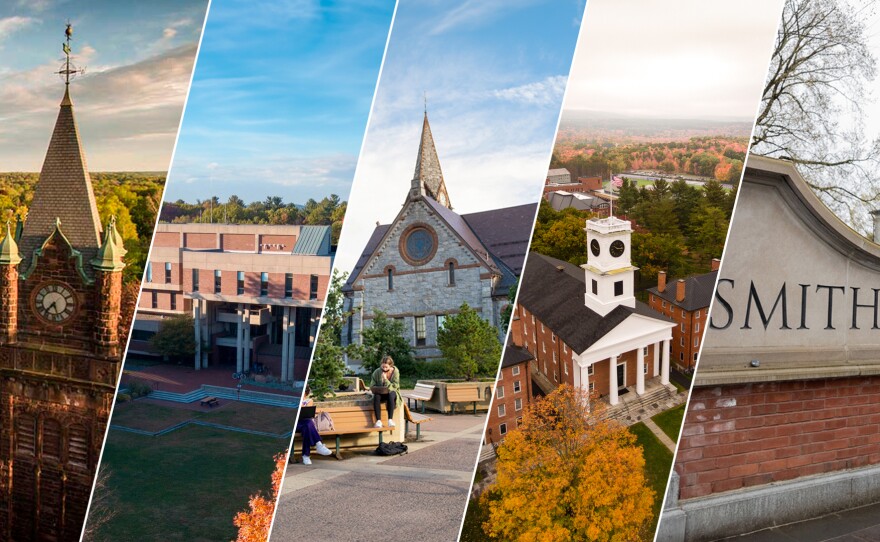
Reporter Diti Kohli of The Boston Globe asked ten school presidents to defend themselves. Among them were the presidents of Amherst College, Hampshire College, Mount Holyoke College, Smith College and Williams College.
She told NEPM’s Jill Kaufman, criticism of academia isn't new, but we're living in a different time.
Diti Kohli: So much of the story of the attacks on universities right now are focused on these big research schools — Harvard, MIT — that were losing all of this money.
But really the core of the argument that the federal government is making is that college, fundamentally of all kinds, is not useful or is failing in its mission.
And liberal arts colleges in particular — which are small, generally left leaning [and] very much seen as the "traditional college experience" — are a part of that attack.
So, we wanted to give the leaders of those universities a chance to speak to the current moment, but also to the very real criticisms of their models that have actually predated the Trump term.
NEPM's Jill Kaufman: Overall, what did you hear from them — their concerns about being under attack in this era as opposed to other times in US history and higher ed?
What's really different about this moment is that there is a lot of credibility to the criticisms that they're facing, about how ideologically homogenous it is on campus in terms of political polarization, in terms of how expensive college has gotten, and I think that they're far more aware of those issues being true and of their role in communicating with the public about what the benefit of their institution still is, even though those criticisms are real.
"We are in like class five rapids right now, and the institutions that have really good paddles and steer together as a team, are going to be the ones who navigate through. And I don't think we should expect to get to calm water; I think we should just get really good at steering."
-Jennifer Chrisler, Hampshire College
Hampshire College President Jennifer Crisler told you, as a college, the school is now experiencing class five rapids and all liberal arts colleges, I believe she's referring to, need to get really good at steering. What are those class five rapids?
I think actually first come first; outside of the political moment we're in, it is the enrollment cliff.
The enrollment cliff, just to explain...
Schools are worried about having a comparable number of students to [what they had] in the past, and they're worried about keeping their budgets afloat to deal with that moment.
The second part is political polarization — the fact that generally, these schools do tend to have mostly liberal students, and that some of the conversation that we're seeing across the country about students self-censoring themselves, about conservative students not speaking out about speakers from different parts of the political spectrum; not feeling welcome.
And the last part of it is really the shifting national focus to what college is supposed to be about.
The Trump administration is really doubling down on this idea of labor outcomes — that colleges should be able to show that their graduates perform better in the marketplace, in the workforce, than if they didn't pursue a college degree. Which, frankly, a growing number of Americans support because colleges get more expensive.
Can you can define a few things, as we're thinking about what these college presidents said. One is, what is a liberal arts education?
You know, traditionally a liberal arts education just means you're getting a broad swath of topics in addition to whatever degree you might be pursuing.
So that's usually courses in history, ethics, philosophy, literature, things that add to your understanding of the world at large.
But it's also, a liberal arts education is actually fundamentally about learning how to think, which is what Hampshire and Smith and Mount Holyoke told me is that, you know, it's preparing students for actually a wide range of options should the career that they choose after college perhaps not exist in the ten years after that.
And that piece of the model is what's lost in the national conversation right now, and what they are essentially being told they should not offer anymore.
"I deeply believe that when you get a liberal arts education, it also has to be an education where we as the universities and colleges help you to understand how that education isn't just good for you — it's good for your family, good for your communities, good for the world. Because if not, then the question is, why do I invest in this?"
-Danielle Holley, President of Mount Holyoke College
Did you find the college presidents to be on the defense at all? You're not the one going after them, but you're asking them to defend who they are.
I would say in a positive way, I think they were largely on the defense. I think it's very much what I've seen in the rest of Massachusetts in this time, where I think partly because of our values, of our state, of how local the state government has been in support of institutions this last year, that people feel like they can speak more freely.
I think President Danielle Holley of Mount Holyoke College, in particular, has always been a very vocal critic of the attacks on education, particularly even a couple of years ago when affirmative action and this whole idea of whether students of color were being given a disproportionate level up.
She was one of the main folks who spoke about that.
So in many ways I think the way that some of these schools are sheltered by this moment, just by geographically where they are, means that these are folks who are pretty vocally on the defense in this moment.
So much of what we talked about in these interviews was their job in selling their own story, which I think they all agreed that they have not actually done a very good job at in the past.
That it is — making the point that some of what the Trump administration is saying is happening on their campuses — is not happening, and that the education that they offer is still worthwhile. And honestly, that's a pretty tall task right now.

