

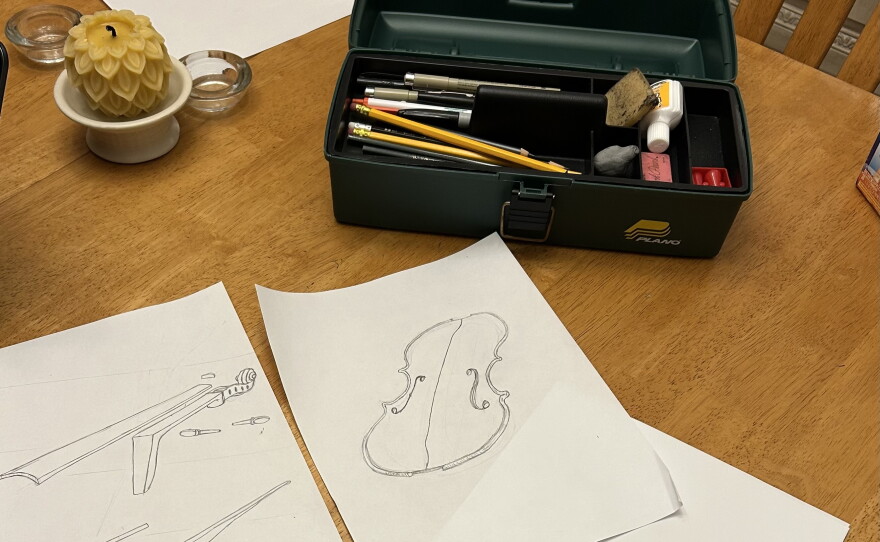

A new novel from a Western Massachusetts author takes readers from World War Two frontlines to a 1950s Manhattan instrument shop, unraveling a high stakes mystery behind a rare Italian cello.
Amherst college instructor Molly Terrill's debut novel is called "The Violin Maker," though the mystery at its heart revolves around a rare Italian cello.
Carrie Healy, NEPM: You open every chapter with a quote from an 1884 manual called "Violin Making As It Was And Is." How did you stumble across that text and why include it?
Molly Terrill, author: So, this was originally not the text I had chosen, and I switched to this one for a very simple reason that haunts many writers, which is that I had to pick something that was in the public domain. [Laughs]
So, I went with this one because I found the way that he writes about instrument making to be very accessible to people who know absolutely nothing about the craft. So, that was why I chose this particular text.
But my intention with the quotations was to set the scene for what was to come in each chapter, but also to take the reader on a journey through this process of building the instrument. So, we start at the beginning stages of the process, and by the end of the book, the quotations have brought us to the completion and the instrument has been built.
The story is constantly also moving between 1950s New York and a centuries old origin story of a cello...or just a little before that. And this is a work of fiction. What draws you to actually use so many things that were actually real in this book?
You know, the 1950s storyline was for the most part, entirely made up, but I stuck much more closely to the historical facts in the late 17th century.
I am a great lover of history. I'm fascinated by it. I love the feeling of thinking that I've discovered something, although of course somebody else has discovered it long before I have. [Laughs]
But I just love that thrill of, 'Oh! Here's this question that I'm gonna get to the bottom of!'
I find it very exciting. And in the case of Pietro Guarneri's life, the historical figures were quite interesting. They had these volatile, in some cases, notorious personalities. And I was hungry to know more about them.
And so I was drawn more to the historical facts in that case. In the 1950s [setting] I guess I gave myself a little more permission to just invent wildly. I based some characters on real people, but the main protagonist in that story and all the events surrounding him (because he's not real) were completely fictionalized.
Mhm. Back to reality. How did teaching at Amherst College and living here in the Pioneer Valley influence or shape your writing?
So, my teaching at Amherst College actually has nothing to do with writing at all. I am on the faculty of the Wellness Department, and I should say, I'm not a professor. I try to be very careful there. I teach yoga, I'm a movement artist.
I actually had a former career as a professional dancer and am now a yoga instructor at Amherst College and at a center in South Hadley.
But, while I was writing this book, I was working for my dad at the family business, which is Stamell Stringed Instruments in Amherst, which has been there for almost 40 years. And I was managing the rental workshop at the time.
So, my dad is a luthier (he's a violin maker himself) and I grew up in this world.
Music and instrument making were a huge part of my life. While I was dancing, this is how I made ends meet, as I sadly do not have the personality to wait tables!
So, I would work in the workshop doing repairs. I was sort of apprenticing, I guess, like learning the craft, deciding if I wanted to pursue that long term as my calling, as my career.
I went with writing instead, but that was how I discovered the instrument in the first place. This [story] is based on a real instrument which is currently in California, and the owner of which has no idea that I've written this book.
Really? Still? They have no idea?
The certificate for this instrument is still very much contested! As recently as last summer, when a new book came out about this Guarneri family of instrument makers.
So, [yes] I did base it on a real instrument. The story is inspired by the events that led to the belief that this was the only cello made by this famous maker.
Wow.
Could you read a passage from early on in the book, uh, where we meet 17th century Italian maker Pietro Guarneri as he navigates court politics for his employer, the Duchess of Mantua. Can you set that scene up for us?
Absolutely. So, in this chapter we are with Pietro Guarneri in Italy at the end of the 17th century, and he has many careers. This was something unusual, actually, for a luthier at the time. So, he was a maker of violins.
He also was a conductor of an orchestra and performed and directed the orchestra for his employer, the Duchess of Mantua, Anna Gonzaga. And so right now in this passage, we are with him as he has just realized, the sticky situation that he has got himself into because of his own actions, and he's preparing to perform for her court.
Once tuned, a weighty silence descended as the musicians made ready to sight-read the piece before them; "Sonata da Chiesa, Op. 3 No. 5 in D Minor" by Arcangelo Corelli. A moment before the small ensemble touched bows and fingers to strings, Pietro looked up and caught the eye of Lucia, standing near the back of the group, chestnut hair gleaming rather dramatically in a ray of sunlight. He averted his gaze from the row of chairs, where the duchess was glaring at him like a serpent preparing to strike.
Released by Koehler Books in October 2026, “The Violin Maker” is written under the name M. Terrill.


