



Western Massachusetts historians now have a bonafide excuse to drink beer on the job.
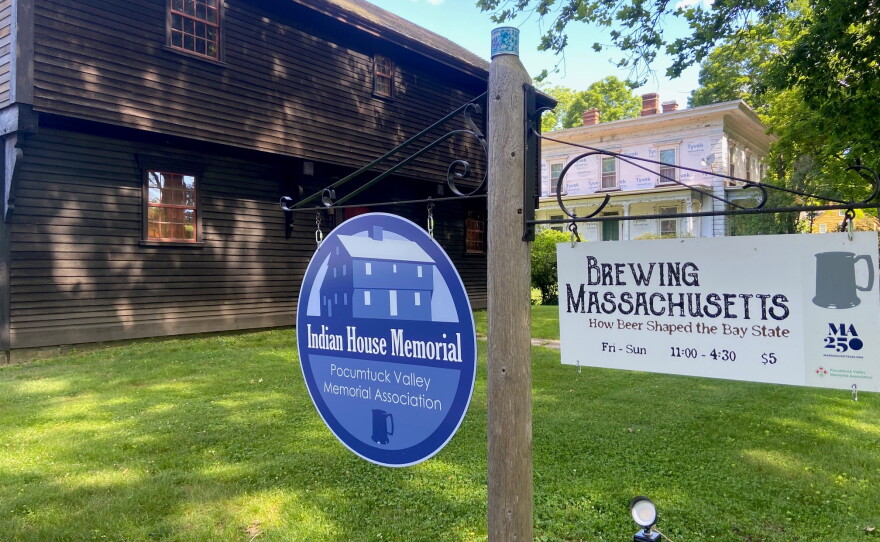
“Welcome to our Colonial Tavern,” said Ray Radigan, holding up a beer stein (albeit empty) at a reconstructed tavern at the Indian House Memorial in Historic Deerfield.
The wood-framed structure is one of the only buildings to survive the 1704 raid in Deerfield. But it’s been renovated for a very different historical purpose.
“We're looking at 425 years of beer in Massachusetts,” he said.
As curator for the Pocumtuck Valley Memorial Association, Radigan joined with the Memorial Hall Museum for the exhibit “Brewing Massachusetts: How Beer Shaped the Baystate.” It focuses on the role of brewing in the state’s growth and development, starting in the 1600s.
“There was actually a law in early colonial Massachusetts that every town had to have a tavern,” he said. “Concord was actually cited for not having a tavern, and avoided a fine by building one, because taverns were the center of social life.”
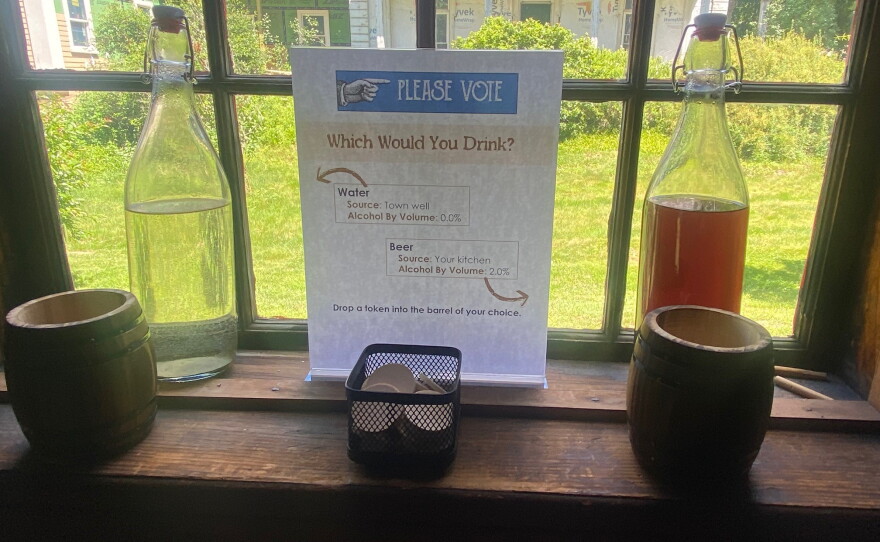
At the time, access to beer was a matter of public health, because many wells were contaminated.
“So drinking water was risky and could make you sick. Beer, however, was safe because in the brewing process the water is boiled, thus killing the bacteria,” Radigan said. “The English didn't know that at that time, but they did know that the people who drink beer don't seem to get sick.”
In fact, beer was part of the official rations for the Continental Army during the Revolutionary war, after Massachusetts put the drink in the state’s rations.
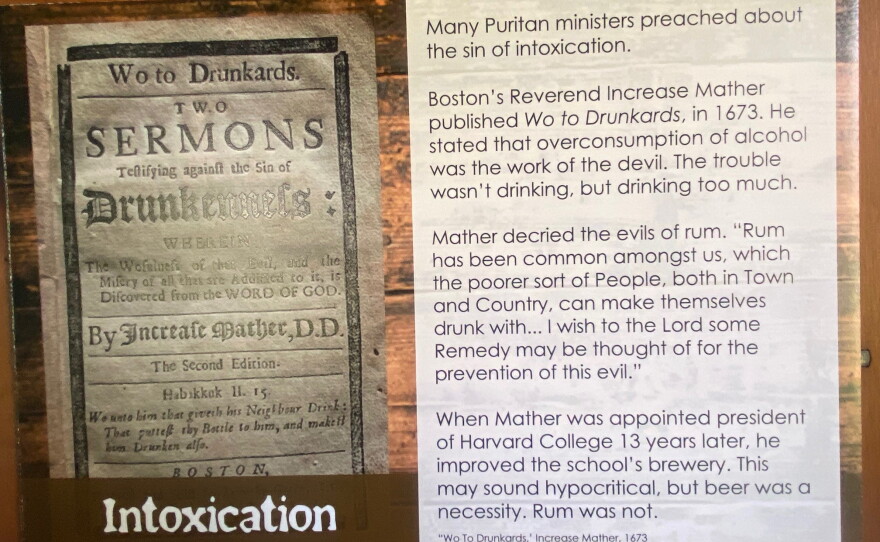
But some of the state’s beer history is quite dark. For example, the early puritans considered alcohol intoxication a moral failure. And Radigan said that led to arbitrary and discriminatory regulations.
“Part of it was really race-based fear. They outlawed drinking among indigenous people because, honestly, they were afraid of what they would consider, quote unquote, drunk Indians,” he said. “The people who could drink with impunity were basically the white colonists.”
That meant primarily the men, even though most actual brewers at the time were women and enslaved people.
Walking around the exhibit, there are vintage saloon signs and furniture, historic liquor licenses, a sermon called “Wo to Drunkards.” Visitors can touch and feel examples of local crops used in beer, if brewers couldn’t get hops from Europe, such as corn, spruce, walnut, pumpkin, and sassafras.
“The first seeds of barley in North America were actually planted on a small island off Martha's Vineyard in 1602,” Radigan said. “We make the argument that that those are the origins of brewing in North America.”
Over the next few centuries, local taverns made way for big business, especially after the industrial revolution.
“All of a sudden these homemade hearth-brewed beers were replaced by these breweries that were four, five, six stories tall, these massive brick buildings that took up entire blocks,” Radigan said. “And the epicenter of the beer industry in the entire country became Boston.”
By the late 1800s, thanks to cheap land, fresh water, and immigrant labor, 40 breweries had opened in Boston.
But the famous Boston beer named for revolutionary leader Samuel Adams didn’t launch for another century. And ironically, Radigan said, Adams himself never actually brewed beer. He inherited his family’s malt shop.
“However, he was also quite unsuccessful at that and ran the malt shop into the ground,” he said.
But by the early 20th century, beer and alcohol in general had lost some of its sheen. The temperance movement arose in response to the sheer amount people were drinking – around seven gallons a year on average, Radigan said, which is more than three times what people drink today.
To show the ways people discouraged drinking, Radigan pointed to a blue ribbon on display, worn by a winner of what was called the Cold Water Pledge. “Which means that they would drink nothing beyond cold water,” he said. “Warm water was a step too far for them.”
Temperance, of course, made way for Prohibition. Massachusetts was the first state to ban alcohol, even before the federal law. Alcohol went underground, which meant it was unregulated and sometimes toxic.
“People got sick, people went blind, people came down with deformities,” Radigan said.
After prohibition ended, the beer industry ramped up again, and consumers started asking for low-calorie beers like Pilsners.
“That turned into Bud Light, Coors Light, Miller Lite, and those breweries took over the entire industry,” he said. “And for the first time in history, beer wasn't local anymore.”
It would be another few decades for craft beer to make its mark. In 1979, President Jimmy Carter legalized home brewing for the first time since Prohibition, ushering in . dense and darker beers like IPAs. Although the craft industry has gone through ups and downs in the past few decades, Massachusetts is still home to more than 200 breweries.
“We're not at the top of the list, but we do have more breweries per capita than most states,” Radigan said.
[See Part 2 in this series for a look at the trajectory of the craft beer industry through the lens of one western Massachusetts brewery.]
But while brewing has been an important economic engine for many towns across Massachusetts, “we also recognize the shortcomings of the industry, including a lack of diversity and representation,” he said.
Since there are only a handful of Black-owned and women-owned breweries in Massachusetts, “you also lose all of the innovation that different people bring,” he said.
The Brewing Massachusetts exhibit is sponsored by the state’s Office of Travel and Tourism, and Radigan himself enjoys beer; his favorite is a special German lager. However, he said they do touch on the downsides of alcohol, and alcohol abuse, from domestic violence to poor health.
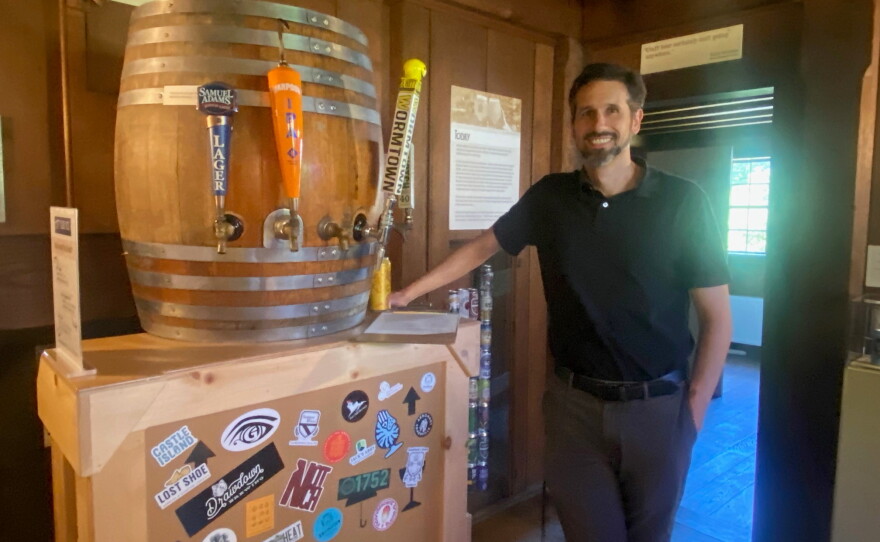
But that’s not the main vibe of the exhibit, which includes a 1970s era living room bar, as well as colorful beer faucets donated by breweries operating within a few miles of the Deerfield museum.
Brewing Massachusetts is open to visitors until October 11.
